Ship sites with style.
Go from design to site with Framer, the web builder for creative pros.
Get Started
Learn More

Assisting Airbnb in refining their accommodation booking process and fostering user retention.
UX STRATEGY
UX RESEARCH
6 min read

PROCESS HIGHLIGHTS
Overview
To grasp UX research and methodologies, we were assigned to evaluate Airbnb from a user experience perspective. While Airbnb is a robust company in the global hospitality industry, the company faces challenges due to the absence of a user engagement and retention strategy, particularly evident in the lack of a loyalty program. Therefore, we conducted extensive research on Airbnb to find areas of improvement.
Problem
Airbnb faces challenges due to the absence of a user engagement and retention strategy. This problem hinders the platform from cultivating user loyalty and engagement, potentially prompting users to explore alternative options. Furthermore, we found the interface design was missing certain elements that decreased the satisfaction of users. Therefore, we asked ourselves:
How might we enhance user engagement and satisfaction with the implementation of a loyalty program, ensuring a seamless integration into Airbnb's user experience and catering to diverse user preferences.
Solution
- Implementing a rewards program: By implementing a rewards program, Airbnb can offer compelling rewards and incentives that retain users and encourage repeated usage of the platform.
- Improve documentation: By providing clear explanations and terminology, users will be able to find what they’re looking for with ease.
- Replace inoperable buttons: Correct broken buttons on the site. Otherwise, provide an error message for the user if the function to adjust preferences is not available for them.
DISCOVERY
Competitive Analysis
Initially, we performed a competitive analysis comparing Airbnb with Booking.com and Vrbo to identify the strengths and weaknesses of Airbnb. Our findings revealed that both Vrbo and Booking.com enjoy a competitive edge over other platforms, primarily attributed to their effective loyalty programs and overall user experience.
"Belong anywhere"

"Make it easier for anyone to travel the world"
“Where Families Travel Better Together”
Competitive Findings
DISCOVERY
User Interviews
We conducted 10 interviews during our usability testing. Our User goal was - To book accommodation for 3 days. During the testing stage, we had a 4 step guide that helped us work through the entire process effectively:
The key findings of user interviews are below👇

DISCOVERY
User Persona
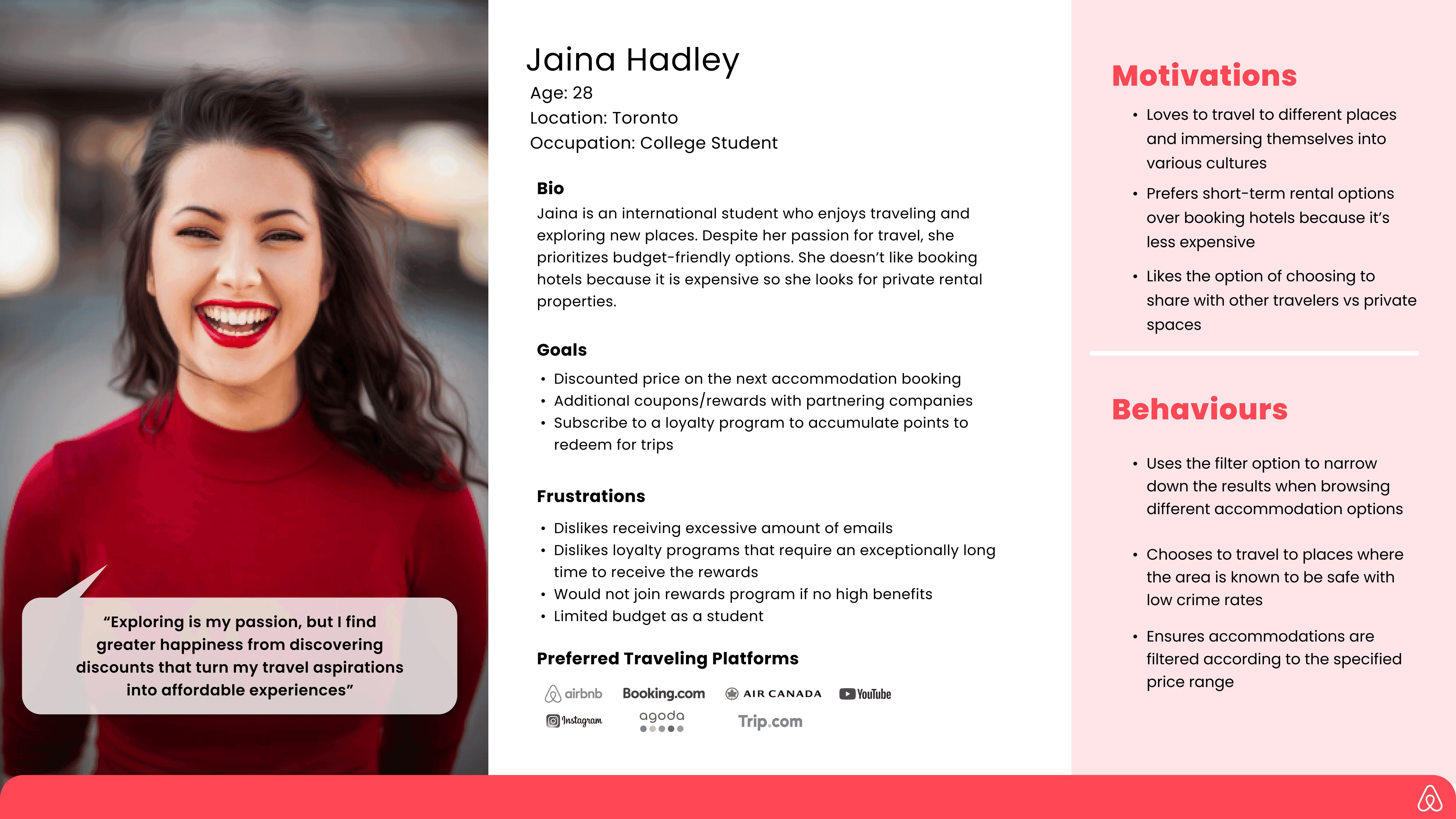
Based on the results of the interviews, we created a user persona that reflects the target Airbnb user. We wanted to understand our users goals, frustrations, motivations, and behaviours that would align with Airbnb's loyalty program.
DISCOVERY
Journey Map
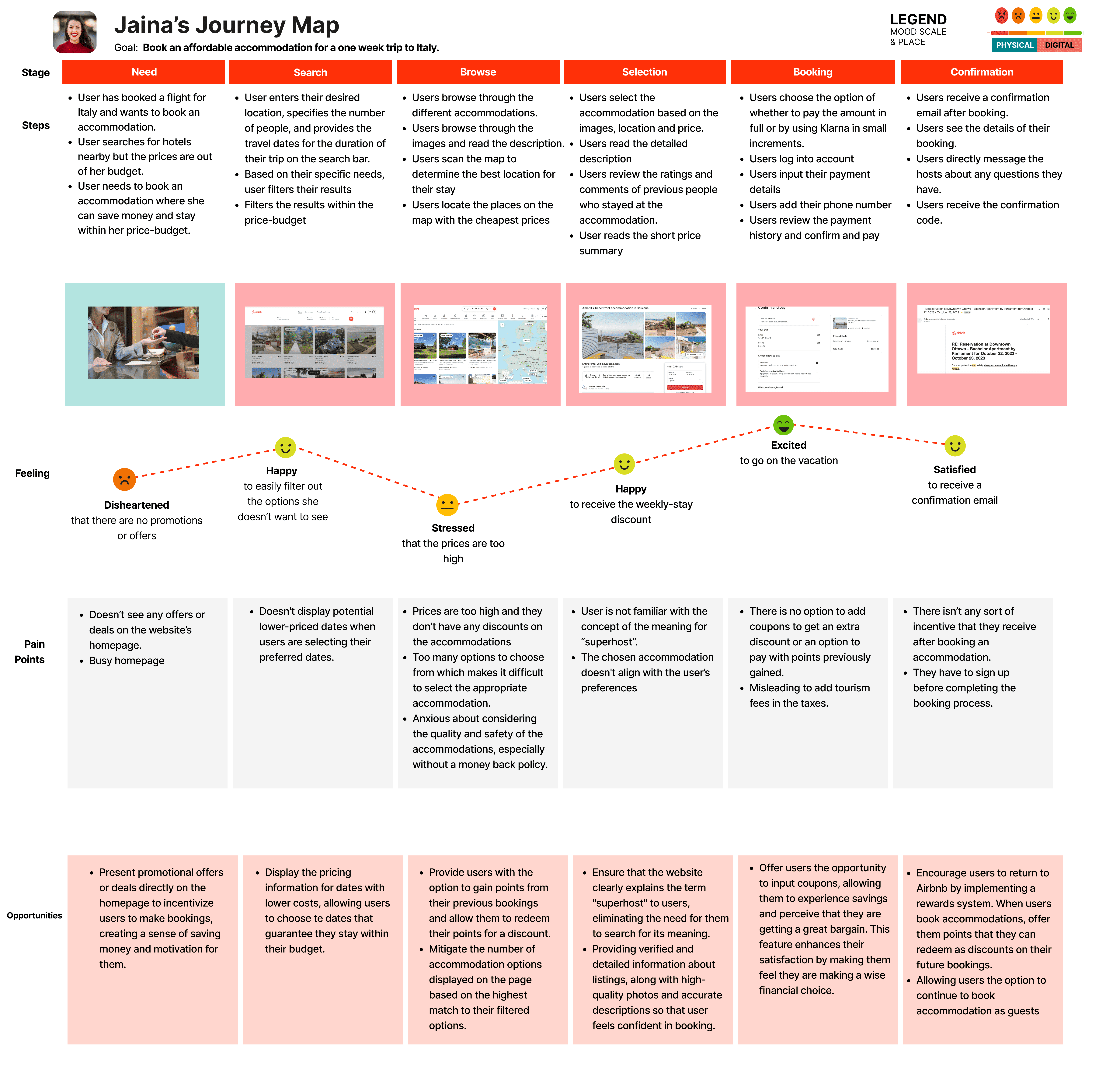
After crafting our user persona, we created a journey map to find out the pain points of Airbnb and the expectations that users would have for a loyalty program.
USABILITY STUDY
Usability Study Steps
Although a journey map allowed us to put ourselves in the user’s shoes, we decided it was best to conduct a usability study to enhance our research insights and observe the user's experience in real time.
We provided an introduction to the purpose of the interview and any necessary background information.
Introduce the interview and sign the consent form:
1
We provided an introduction to the purpose of the interview and any necessary background information.
Screener Questions:
2
We provided an introduction to the purpose of the interview and any necessary background information.
3
Usability Testing:
We provided an introduction to the purpose of the interview and any necessary background information.
Analyze Data:
4
USABILITY STUDY
Usability Study Findings
Following the usability study, we looked at the participant's behaviors and pain spots. Based on the investigation, we were able to derive the following conclusions, which are ranked according to the level of severity of the heuristics violated:
Excessive Information/Categories
HEURISTICS VIOLATED: Documentation Level 1
A large number of options made it challenging for the participant to decide on which type of accommodation to choose from, delaying their booking process.
Users struggle to prioritize and focus on essential elements, affecting the overall usability of the interface.
The excessive categories impacted the web-to-mobile transition of the platform as well, when on the go, it was challenging to keep scrolling looking for an exact listing on their mobile.
“Interfaces should not contain irrelevant information. Every extra unit of information in an interface competes with the relevant units of information.”
Inoperable buttons/navigation
HEURISTICS VIOLATED: Error Prevention Level 2
During the checkout process, there is an option to edit certain trip details such as guest number, room number, and date preferences. This is a shortcut for users who do not want to input that data earlier in the process, or if they have last-minute changes.
Despite this option being provided, it does not always work and adjusts the user’s preferences when interacted with.
This has resulted in inoperable buttons for some users during the booking process.
"Good error messages are important, but the best designs carefully prevent problems from occurring in the first place.”
Non-functional 3 day reservation
HEURISTICS VIOLATED: Visibility of System Status Level 3
- Providing the option to choose a specific number of days is a rare feature, and participants were unsure about the outcome after clicking on it.
- Selecting the “3-Day” option produced no outcomes which implies that this feature has no purpose.
- Providing no feedback after clicking this option led to the participant feeling uncomfortable when proceeding further.
“Designs should keep users informed about what is going on, through appropriate timely feedback”
REFLECTIONS
Post Research Reflections
Takeaways
Focus on the real user problems
Understanding the user is just as important as testing designs
Always take notes, even when you're recording
Next Steps
Brainstorm/planning for a loyalty program
Start the design process
Create wireframes and prototypes
Conduct usability testing